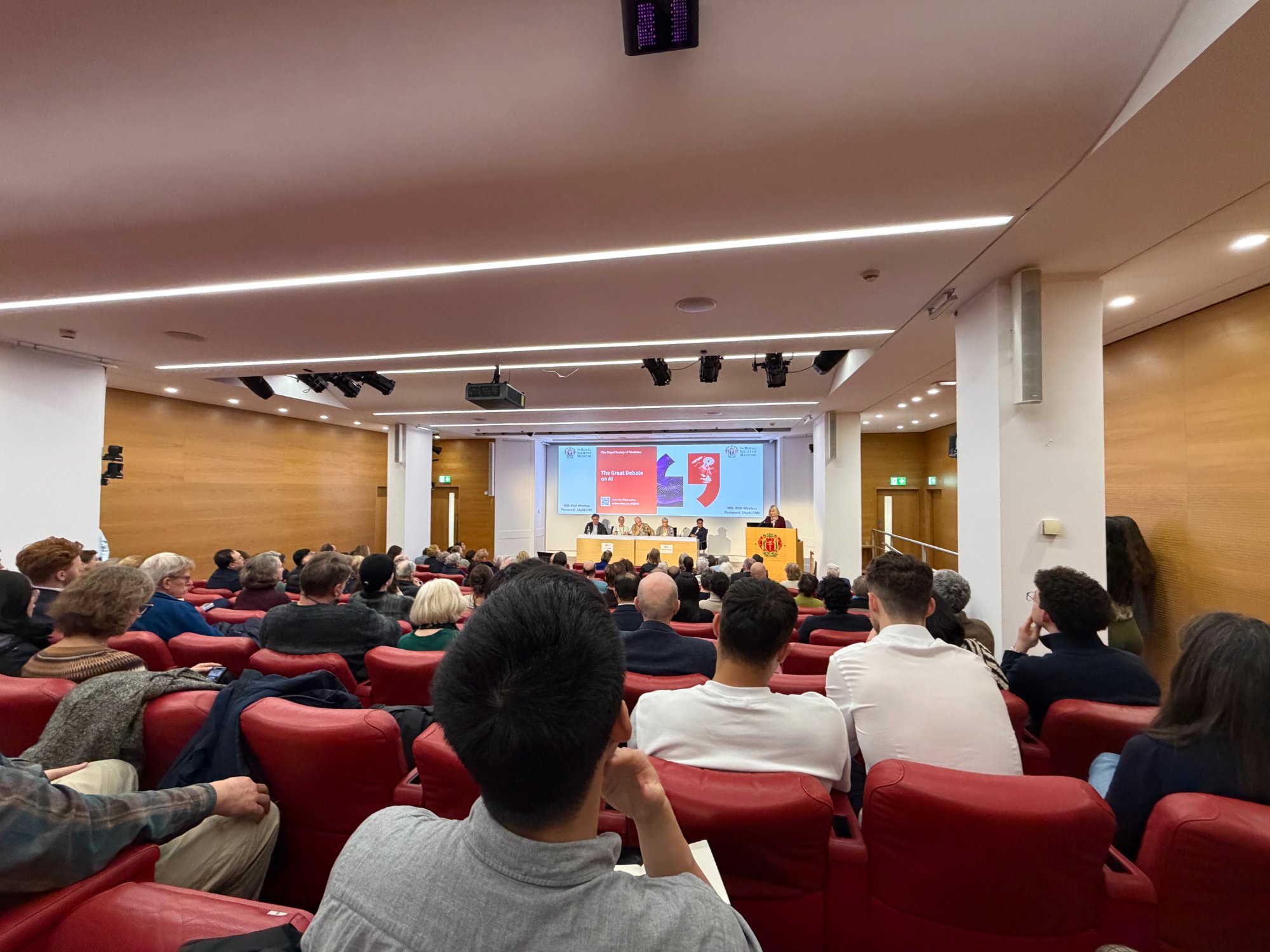
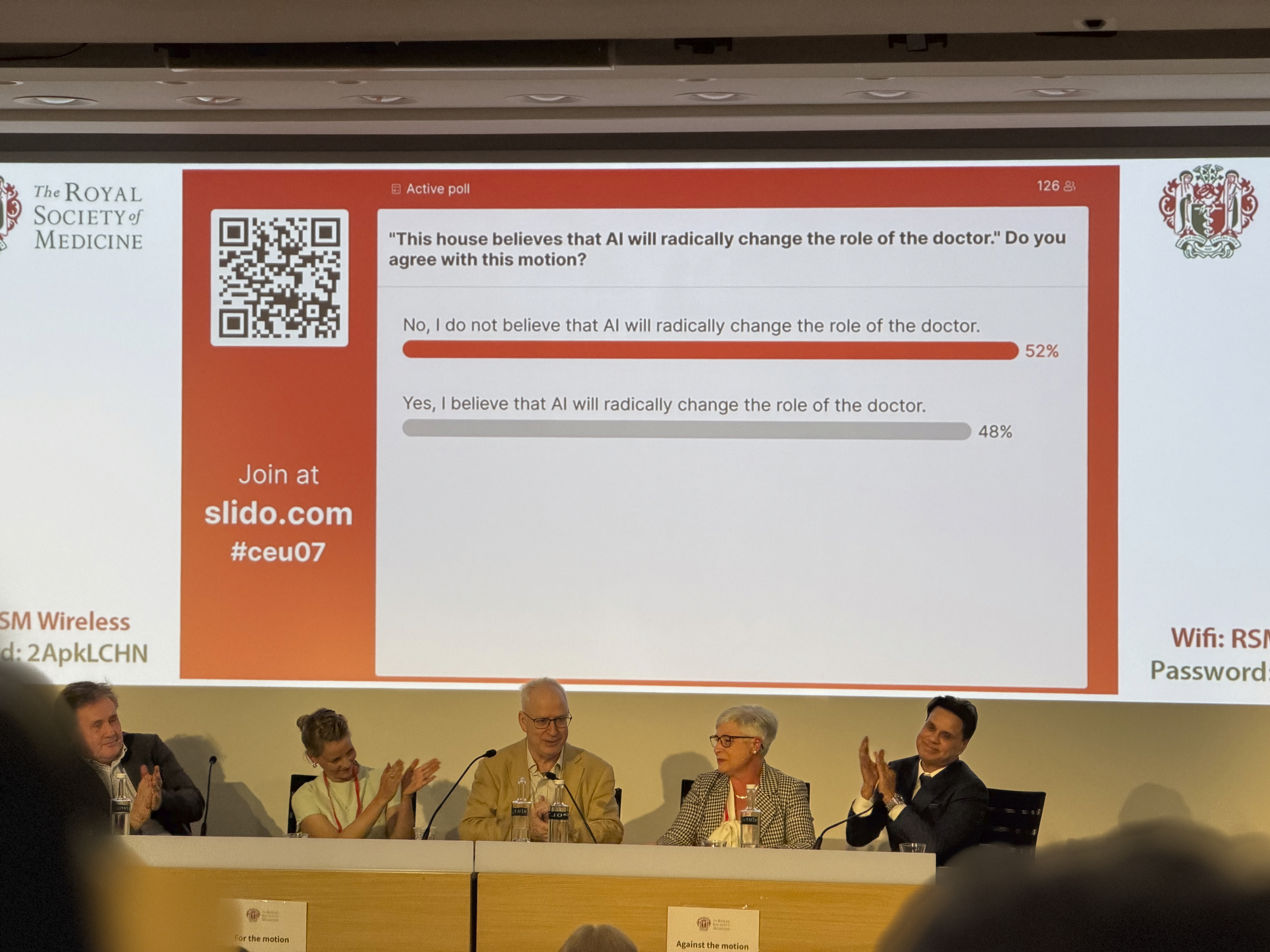
Something remarkable happened at the Royal Society of Medicine this evening. A room full of doctors, surgeons, medical students and health policy leaders was polled on a single motion: "This house believes that AI will radically change the role of the doctor." Seventy-five percent voted yes. Ninety minutes of debate later, the majority had reversed their position: 52% now voted no. A 27-point swing. In an era saturated with AI hype, a room of medical professionals listened to the evidence, heard the arguments, and collectively pumped the brakes.
I was there. As a surgeon who uses AI tools in clinical practice and follows this space obsessively, I went in expecting the motion to carry comfortably. What I witnessed instead was a masterclass in persuasion, intellectual honesty, and (whether they intended it or not) applied game theory.
The Motion and the Speakers
The debate was chaired with characteristic wit by Professor Sir Simon Wessely, Past President of the RSM, and introduced by Professor Gillian Leng CBE, the current RSM President. Four speakers took the stage: two for the motion, two against.
For the motion:
Dr Annabelle Painter, Clinical AI Strategy Lead at Visiba and host of the RSM Digital Health podcast, opened with a powerful metaphor. Doctors, she argued, are standing on a shoreline watching an AI wave build on the horizon. The technology is already democratising what has historically been ours alone: medical knowledge, clinical records, and clinical reasoning. She painted a vivid picture of a future where a "personalised medical oracle" is available to the public on demand, deeper than any specialist, broader than any generalist. Her conclusion: if most of what a doctor does today is no longer what they do tomorrow, that is by definition a radical departure.
Professor Paul Leeson, Professor of Cardiovascular Medicine at the University of Oxford and a newly appointed NHS Senior Investigator, took a pragmatic approach. He argued that the role of the doctor has always been defined by patients' expectations and by the other healthcare professionals we work alongside, not by doctors themselves. Those expectations are already shifting. Patients arrive in clinic having consulted ChatGPT before consulting their cardiologist. Paramedics, pharmacists, and nurses are being handed AI tools that are redistributing clinical decision-making. Whether we like it or not, he argued, radical change is happening around us and we must adapt our role to meet it.
Against the motion:
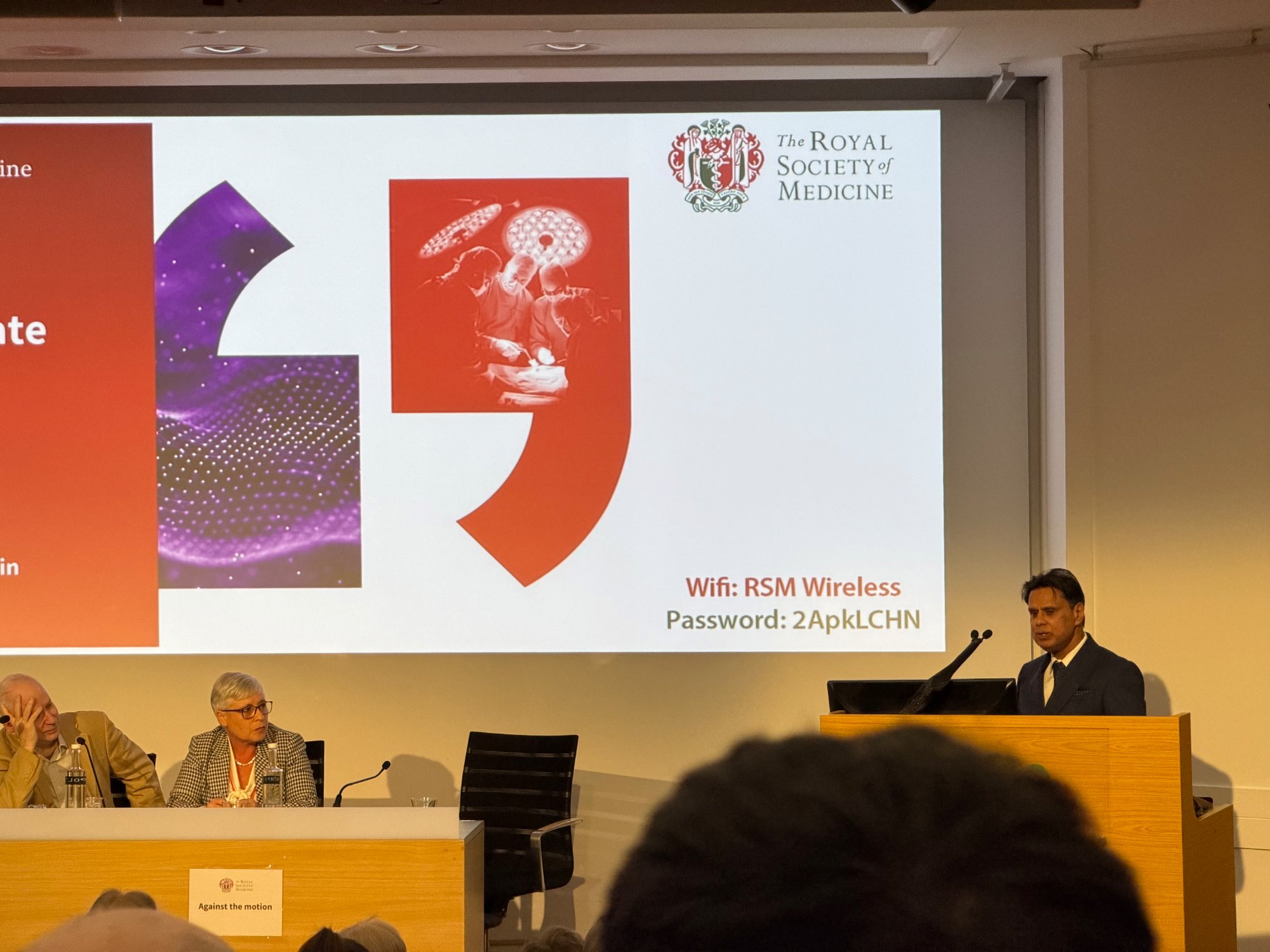
Professor Shafi Ahmed, Consultant Surgeon at Barts Health, 3x TEDx speaker, and one of the most recognised figures in global health innovation, delivered what I can only describe as a strategic masterstroke. Here is a man known as "the digital surgeon," who has built countries in the metaverse and co-founded multiple health tech companies, and he stood up to argue against AI radically changing the doctor's role. The cognitive dissonance was deliberate and devastating. He walked the audience through the clinical reality of breaking bad news to a cancer patient, the irreplaceable intuition forged by years in the operating theatre, and the sobering fact that despite over 200 FDA-approved radiology AI companies, only 2% of US hospitals use AI daily. His framing was simple: AI will support doctors, not supplant them. We have always adapted to new technologies, from fire to the printing press to the internet, and we have never lost our core identity in the process.
Professor Erika Denton, Consultant Radiologist and former National Medical Director for Transformation at NHS England, reinforced this with clinical precision. She argued that AI is best understood as simply the next in a long line of technological advances, from the stethoscope to antibiotics to genomics, that have changed how doctors work without changing what doctors fundamentally are. The skills required to navigate uncertainty, explain risk, and make shared decisions with frightened, vulnerable patients are not being disrupted. They are needed now more than ever. Her rebuttal to the hype was pointed: Geoffrey Hinton predicted in 2016 that radiologists would be redundant within five years. In 2020, the Mayo Clinic appointed 47 new board-certified radiologists.
Why the Opposition Won: A Lesson in Framing
The genius of the opposition's strategy (and this is where it becomes a game theory problem) was in how they reframed the word "radical." The motion's supporters had to defend the strongest possible interpretation: that AI represents a fundamental break with the past. The opposition simply had to redefine the change as evolutionary rather than revolutionary. Professor Ahmed and Professor Denton effectively shifted the Overton window. They conceded that AI will change medicine enormously, but argued this is simply what medicine has always done. Same purpose, same humanity, different tools. By the time the audience voted again, that reframe had landed.
From where I sat, both sides were largely in agreement on the facts. AI will automate administrative burden. It will accelerate diagnostics. It will empower patients. The disagreement was philosophical: is this a rupture or a continuation? And on that question, the room decided it was a continuation.
What This Means for Patients
If you are a patient reading this, the message from tonight's debate should be reassuring rather than alarming. The doctors in that room, including some of the most senior AI advocates in the country, were unanimous on one point: the human relationship at the heart of medicine is not going anywhere. What is changing is the scaffolding around it. AI will handle more of the administrative weight, freeing your doctor to do what they trained to do: listen, examine, reason, and care.
As a facial plastic surgeon, I already use AI ambient scribing tools in my consultations. They have transformed my administrative workflow. But the conversation I have with a patient about their goals, their anxieties, their face: that remains irreducibly human. Tonight's debate confirmed what I have long believed: AI is the most powerful tool medicine has ever been given. But a tool is only as good as the hands that hold it.
The Great Debate on AI was hosted by the [Royal Society of Medicine](https://www.rsm.ac.uk/events/rsm-studios/2025-26/ceu07/) on 30 March 2026. The event was free, CPD-accredited, and open to all.